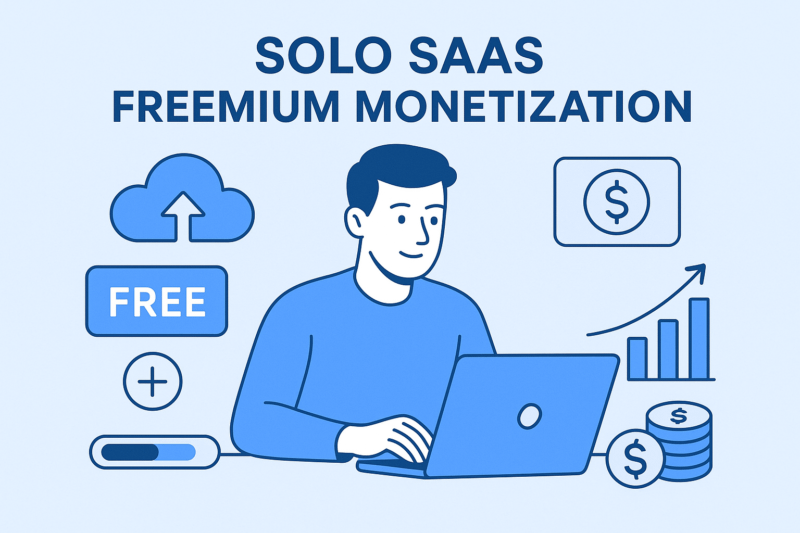
What solo founder passive income SaaS actually means
When you picture a solo founder passive income SaaS, you might imagine launching an app, flipping a switch, then watching revenue roll in while you sleep. In reality, passive is the destination, not the starting point. You do the hard, focused work upfront so your product can mostly run on autopilot later.
As a non technical founder, your main job is not to write code. Your main job is to pick the right problem, shape a simple solution, and set up a system that can grow without you handling every little task. Once you see it this way, building a profitable SaaS becomes a lot less mysterious.
Choose a problem that prints recurring revenue
Not every idea works well as a solo founder passive income SaaS. The best ones solve an ongoing, annoying problem for a specific group of people who are already used to paying for software.
Look for recurring, painful problems
You want a problem that:
- Happens every month or every week
- Costs your users time, money, or reputation
- Has clear, measurable outcomes when solved
For example, an agency owner who spends hours each month assembling client reports will gladly pay to automate that job. A creator who struggles to track membership renewals will pay for a tool that protects their income.
If solving the problem saves someone more money or time than your monthly price, you have the foundation for strong recurring revenue.
Narrow your audience, do not chase everyone
You are not trying to build the next all in one platform. You are trying to build the best possible solution for a small, clearly defined group.
Instead of “project management for everyone,” think “simple client portal for freelance designers” or “status update tracker for HR teams that run quarterly reviews.” The smaller the niche, the easier it is to find and speak to your customers.
A quick way to test your niche is to write one sentence:
You help [specific person] solve [specific painful problem] with [simple software outcome].
If that sentence is fuzzy, keep narrowing.

Design a product a non technical founder can manage
You do not need complex AI or a dozen features to make money. Complexity is the enemy of speed and passive income, especially for a solo founder.
Start with a single core outcome
When a user logs in, they should be able to achieve one clear outcome in a few clicks. Everything else is optional.
Examples of strong single outcomes:
- Turn raw numbers into a clean PDF report
- Collect and organize customer feedback in one place
- Turn a spreadsheet into an automated notification system
If you are unsure what to build first, ask, “What is the very first obvious win for a new user?” That is your minimum viable product.
Pick a simple pricing model early
Passive income SaaS works because of recurring payments. You want a plan that is easy to explain and easy to charge for.
Most solo founders do well with one of these:
- A single flat monthly price with a free trial
- A simple tiered structure based on usage, for example number of clients or projects
- A starter plan plus a “pro” plan for power users
You can always refine your pricing later. The important part is to avoid long sales cycles, manual quotes, or custom pricing that requires you to be involved in every deal.
Turn your lack of coding skills into an advantage
If you do not write code, your job is to stay out of the way of the technical work and double down on customer understanding and growth. That can actually be a strength.
Focus on the parts only you can do
As a non technical solo founder, you are the expert in:
- Understanding your audience’s language and day to day struggles
- Testing ideas with real people before anything is built
- Shaping the product so it feels intuitive and valuable
- Talking to early users and turning feedback into improvements
These are exactly the skills that many technical founders struggle with. Lean into that advantage.
Work with the right technical partner
Whether you hire a freelancer, a small agency, or a long term product partner, look for someone who:
- Has shipped SaaS products before, not just websites
- Understands recurring billing, user accounts, and security basics
- Communicates clearly without jargon
- Is willing to iterate in small, testable steps
This partnership is what allows you to move fast without getting lost in technical details. Your goal is not to micromanage the code, your goal is to protect the user experience and the business model.
Build for automation from day one
If your goal is passive income, you need your SaaS to run with as little manual work as possible. That starts with how you design your systems.
Make signups and onboarding self serve
Users should be able to:
- Land on your site
- Understand what you do within seconds
- Start a free trial or low friction demo without talking to you
- Get guided through the first setup steps with clear prompts
A short email onboarding sequence can walk them to their first win. Think in terms of “Day 1,” “Day 3,” and “Day 7” emails that nudge them to use the key features.
Integrate billing and support workflows
You want:
- Automatic subscriptions and renewals through a platform like Stripe or Paddle
- Clear, automatic receipts and invoices
- A help center with simple articles and short videos answering common questions
- A shared inbox or ticket system so you do not lose track of requests
The more routine questions you answer once in a help article, the less time you spend replying to the same emails over and over.
Grow with one or two simple acquisition channels
You do not need to master every marketing tactic. You only need one or two reliable ways to bring new users into your solo founder passive income SaaS.
Pick channels that match how your audience already behaves
Ask yourself:
- Where do they go to solve work problems, Google, YouTube, niche communities
- What do they already read or watch, blogs, newsletters, podcasts
- Who do they already trust, industry leaders, tools they currently use
If your users live in specific online communities or LinkedIn groups, show up there. If they search Google when they have a problem, create focused content that answers those searches and naturally introduces your tool.
Make content work like a quiet salesperson
You do not need long thought pieces. You need short, practical content that:
- Names the exact problem your SaaS solves
- Shows a small before and after
- Ends with a clear invitation to try your product
Over time, this content builds trust and keeps feeding your trial pipeline without you chasing every lead manually.
Use metrics to steer toward real passive income
Passive income does not mean ignoring your metrics. A few simple numbers will tell you if you are on track or slowly leaking revenue.
Watch these three numbers first
At the beginning, focus on:
- New trials or signups per month
- Conversion from trial to paid
- Monthly churn, how many paying users cancel each month
If many people sign up but few pay, your onboarding or pricing needs work. If people pay once then leave quickly, the product is not delivering enough ongoing value, or users are not fully adopting key features.
You do not need a giant analytics stack. A basic dashboard that shows these numbers each month is enough to guide your decisions.
Gradually remove yourself from daily operations
At first, you will be involved in everything. Over time, you want to steadily replace yourself with systems and lightweight help so the business can run even when you are offline.

Document your recurring tasks
For a few weeks, keep a simple log of everything you do for the SaaS. Then group these tasks:
- Customer support
- Billing and admin
- Marketing and content
- Product decisions
For each group, ask, “Can this be automated, turned into a template, or handed off part time?” Support replies can become help articles. Marketing posts can be scheduled in batches. Admin work can be delegated to a virtual assistant a few hours a week.
Decide what “passive enough” looks like
Completely zero effort is rarely realistic. Instead, aim for a business that:
- Runs day to day with minimal supervision
- Needs you mostly for strategy and occasional product decisions
- Gives you the flexibility to step away without everything stopping
When you define that target clearly, you can make a realistic plan to reach it, instead of chasing an undefined dream.
Start small, move fast, and let the flywheel build
You do not need a big launch, investors, or a huge team to build a solo founder passive income SaaS. You need a sharp problem, a simple product, and a commitment to small, consistent improvements.
Begin with the smallest version of your idea that can deliver a clear win for a narrow audience. Work with a technical partner who translates that into a stable, easy to use product. Put simple systems in place so signups, billing, and support do not eat your time.
Then keep asking the same questions each month:
What can you automate, simplify, or hand off next, and what small improvement will make the product so useful that people are happy to keep paying for it?
Answer those two questions well and you will steadily move from active hustle to genuinely resilient, mostly passive SaaS income.
John Beluca is a Solutions Architect and founder of Procedo, with 20+ years of experience building custom CRMs and internal tools that simplify business processes.
All author posts