What solo founder profit methods really mean
When you picture launching a SaaS product as a solo founder, you probably imagine long feature lists, complex tech stacks, and big funding rounds. In reality, the solo founder SaaS profit methods that work best are usually simple, focused, and built around one clear customer problem.
Instead of trying to build everything at once, you can design a lean offer, validate it quickly, and monetize in stages. You do not need to write code yourself. You do need a clear vision, a narrow audience, and a practical plan for how your product will earn revenue from day one.
If you would like a deeper dive into specific revenue models, you can also explore how solo founders generate revenue in more detail at how solo founders generate revenue.
Start with a narrow, profitable problem
Every strong SaaS idea starts with a sharp definition of the problem. The more specific you are, the easier it is to build, sell, and support.
Think in terms of one audience, one painful problem, and one core outcome. For example, instead of “project management,” you could focus on “help solo marketing consultants send weekly client status reports in 5 minutes.”

When you narrow your problem:
- Your product can stay small and focused
- Your marketing message becomes clearer
- Your pricing becomes easier to justify
A narrow problem is not a limitation. It is the foundation that lets you charge real money for a very specific result.
Choose a simple revenue model first
You do not have to invent a new business model to profit as a solo founder. Start with a simple structure that matches how your customers already like to pay.
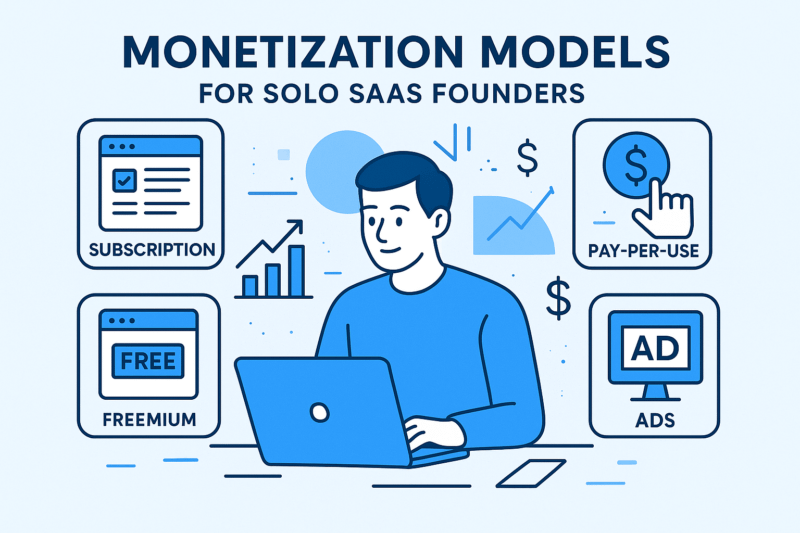
Common solo founder SaaS profit methods include:
- Monthly subscription
- Annual plans with a discount for commitment
- Usage based or tiered pricing for growing customers
Monthly subscriptions are usually the easiest place to start. They create predictable revenue and align well with ongoing value. Once you have customers, you can experiment with higher tier plans and annual options.
If you are just getting started, aim for one default plan that covers most use cases, plus a higher tier for power users. You can add more complexity later when you have data and real feedback.
Pre sell before you build
As a non technical founder, it is tempting to hire a developer or partner, build the full product, then go find customers. This is usually backwards, and it increases your risk.
Instead, you can pre sell. That means you talk to your target audience, present your concept, and ask them to commit money or time before the product is finished.

You might:
- Offer a discounted “founding customer” rate for early adopters
- Run a limited beta with clear start and end dates
- Sell a small pilot to one company and build around their needs
Pre selling tells you if your idea has real demand. It also funds early development, which is especially helpful if you are bootstrapping. Even a handful of pre sale commitments can validate your pricing and offer.
Turn services into SaaS revenue
Many profitable solo SaaS founders begin with a service. If you currently consult, freelance, or provide done for you work, you already have a path into software.
You can look for ways to:
- Productize your service into a repeatable process
- Automate parts of that process with software
- Offer your service plus access to your tool as a bundle
For example, if you run client onboarding manually today, your early “SaaS” could be a mix of a light tool plus a premium onboarding service you still run. Over time, you shift more of the value into the software, while keeping your service as a high ticket add on.
This hybrid model lets you charge higher prices at first, build deeper relationships, and gradually transition to recurring product revenue.
Use a “tiny product first” approach
You might feel that your idea needs a full feature set to be taken seriously. In practice, a tiny, well designed tool that solves one task often sells faster than a bloated platform that tries to do everything.
A “tiny product first” approach looks like this:
- Identify the smallest version of your idea that still delivers a clear result
- Build that version only, with a clean, simple interface
- Launch quickly to a small audience, even if it is just your network
- Charge right away, even if the price is modest
By shipping a small version first, you learn what customers care about and what they ignore. You can then expand in ways that drive revenue, not in ways that just add maintenance work.
Make upgrades and add ons part of the plan
Solo founder SaaS profit methods work best when you think beyond the first sale. You do not need aggressive upsells or complex funnels, but you do want a path for customers to grow with you.
You can design natural upgrade points such as:
- Higher usage limits when customers hit thresholds
- Advanced features that unlock after initial success
- Priority support or onboarding for growing teams
These upgrades should feel helpful, not pushy. Customers should see them as the next logical step to keep getting value, not as obstacles to basic use.
Even simple add ons, like a setup package or a one time training session, can provide meaningful extra revenue while you are still small.
Focus your marketing on proof, not polish
In the early stages, your product will not be perfect, and that is fine. What matters more is proof that it helps people like your target customers get results.
Instead of spending most of your time on logos and design details, focus on:
- A clear landing page that explains who your product is for and what it does
- A concise demo or walkthrough video
- Short case studies or testimonials as soon as you have them
You want visitors to see themselves in your examples. If you help accountants close their books faster, show real numbers and real scenarios. Specific proof does more for sales than generic claims or buzzwords.
Partner with the right technical support
Since you are not handling the coding yourself, choosing the right technical partner is part of your profit strategy. The wrong build can lock you into high ongoing costs or slow delivery.
Look for a partner who:
- Understands lean MVP development and small, testable releases
- Can suggest low code or no code options when appropriate
- Communicates in plain language and helps you understand trade offs
You want someone who treats your budget as if it were their own, and who thinks about your long term ability to maintain and extend the product.
A good technical partner will help you prioritize features that affect revenue first, such as onboarding flows, billing, and the key actions that deliver value to customers.
Measure what matters for profit
Once your SaaS is live, your numbers tell you which profit methods are working and which need refinement. You do not need an advanced analytics setup to start, but you do need a few simple metrics.
At minimum, track:
- New signups each month
- Conversion rate from trial or demo to paid
- Average revenue per user
- Churn rate, or how many paying customers cancel
These metrics show you where to focus. If many people sign up but few convert, you might improve onboarding or clarify your value. If customers convert but churn quickly, you might revisit your promise, support, or pricing.
Over time, you can layer in more detailed tracking. For your first version, clear, basic numbers are enough to guide smart decisions.
A small, focused SaaS with a clear audience and simple revenue model will often outperform a bigger, more complex idea that tries to serve everyone.
Bringing your SaaS idea to life
Your SaaS idea does not need massive funding or a full in house team to succeed. You can use solo founder SaaS profit methods to keep things lean, validate early, and grow steadily.
Start with one narrow problem and one clear revenue model. Pre sell where you can, consider blending services with software at first, and launch a tiny product instead of waiting on a complete platform. Partner with the right technical support so you can focus on vision, customers, and revenue, while they handle the build.
If you keep your decisions tied to profit and customer outcomes, your idea can move from concept to a real, sustainable SaaS business faster than you might expect.
John Beluca is a Solutions Architect and founder of Procedo, with 20+ years of experience building custom CRMs and internal tools that simplify business processes.
All author posts